
The wide-ranging set of decisions, resolutions and statements that constitute the outcome of COP26 is the fruit of intense negotiations over many weeks, strenuous formal and informal work over many months, and constant engagement both in-person and virtually for nearly two years.
India represents 17% of the global population, its historical cumulative emissions are only 4%, while current annual GHG emissions are only about 5%. India is always committed to the United Nations Framework Convention on Climate Change (UNFCCC) Framework and its Paris Agreement and played a critical role COP26 and assured the world, that India will work constructively for successful and balanced outcome of the decisions taken at the summit.
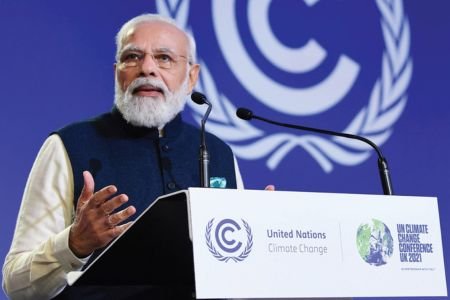
Prime Minister Narendra Modi said, “In the midst of this global brainstorming on climate change, on behalf of India, I would like to present five nectar elements, Panchamrit, to deal with this challenge. First- India will reach its non-fossil energy capacity to 500 GW by 2030. Second- India will meet 50 percent of its energy requirements from renewable energy by 2030.
Third- India will reduce the total projected carbon emissions by one billion tonnes from now onwards till 2030. Fourth- By 2030, India will reduce the carbon intensity of its economy by less than 45 percent. And fifth- by the year 2070, India will achieve the target of Net Zero. These panchamrits will be an unprecedented contribution of India to climate action.”
He urged the world leader for transfer of climate finance and low-cost climate technologies. India expects developed countries to provide climate finance of $1 trillion at the earliest. He said, it is important that it is necessary that as we track the progress made in climate mitigation, we should also track climate finance.
The proper justice would be that the countries which do not live up to their promises made on climate finance, must be pressured too. “I consider it as my duty to raise the voice of developing countries,” Modi stated.
India is of the view, that all Parties need to immediately contribute their fair share and achieving this would require developed countries to rapidly reduce their emissions and dramatically scale-up their financial support to developing countries.
The issues were reiterated by Environment Minister Bhupendra Yadav. He pointed that developed countries have not only failed to meet the $100 billion goal per year of support to developing countries each and every year since 2009, but they also continue to present the 2009 goal as the ceiling of their ambition all the way to 2025. In a context where developing countries, including BASIC (Brazil, South Africa, India and China) countries, have massively stepped up their climate actions since 2009, it is unacceptable that there is still no matching ambition from developed countries on the enabling means of implementation on climate finance support. To reinforce India’s commitments’, a web portal on electric vehicles (EVs), was launched at the COP26 Summit in Glasgow, UK.
E-Amrit is a one-stop destination for all information on electric vehicles— busting myths around the adoption of EVs, their purchase, investment opportunities, policies, subsidies, etc. The portal has been developed and hosted by NITI Aayog under a collaborative knowledge exchange programme with the UK government and as part of the UK–India Joint Roadmap 2030, signed by the Prime Ministers of the two countries. E-Amrit intends to complement initiatives of the government on raising awareness on EVs and sensitizing consumers on the benefits of switching to electric vehicles. In the recent past, India has taken many initiatives to accelerate the decarbonization of transport and adoption of electric mobility in the country. Schemes such as FAME and PLI are especially important in creating an ecosystem for the early adoption of EVs.