An Analysis of Emerging Power Equations and India’s Expanding Global Influence
In September 2025, the Shanghai Cooperation Organisation (SCO) Summit in Tianjin marked a pivotal moment in Eurasian diplomacy. The joint appearance of Prime Minister Narendra Modi, President Vladimir Putin, and President Xi Jinping was not merely ceremonial—it reflected a recalibration of strategic priorities amid global instability. As the world grapples with economic fragmentation, regional conflicts, and shifting alliances, the trilateral relationship among India, China, and Russia has emerged as a complex yet consequential axis of influence.
Let’s explore the evolving dynamics among these three powers, India’s growing global stature, and the nuanced shifts in Chinese and Russian foreign policy. Drawing on summit outcomes, trade data, diplomatic statements, and strategic frameworks, it argues that India is increasingly seen as a stabilizing force and a bridge between rival blocs in a multipolar world.
One of the most consequential developments in recent geopolitics has been India’s firm refusal to align with U.S. sanctions against Russia following the Ukraine conflict. Despite intense diplomatic pressure from Washington—including public statements, congressional hearings, and backchannel negotiations—India continued to import Russian crude oil, expand defense cooperation, and participate in Eurasian forums such as BRICS and SCO.
Between FY 2021–22 and FY 2024–25, India’s imports of Russian oil surged from $2.5 billion to over $50 billion, according to the Ministry of Commerce and Industry. This defiance was not merely transactional—it was strategic. India cited its energy security needs, inflationary pressures, and sovereign decision-making as the basis for its stance. As External Affairs Minister Dr. S. Jaishankar stated at the Munich Security Conference 2024, “Europe has to grow out of the mindset that its problems are the world’s problems. India will do what is best for its people.”
The U.S. response included tariff hikes on Indian steel and aluminum exports, delays in defense technology transfers, and a temporary freeze on certain bilateral dialogues. However, these punitive measures failed to isolate India. Instead, they catalyzed a deeper convergence between India, China, and Russia—three nations that, despite historical tensions, found common ground in resisting Western coercion and promoting multipolarity.
At the SCO Summit in Tianjin, the joint communique emphasized “respect for sovereign choices in trade and energy partnerships,” a veiled rebuke to unilateral sanctions regimes. China, which had previously maintained a cautious distance from India post-Galwan, began re-engaging through trade facilitation, diplomatic outreach, and multilateral coordination. Russia, already pivoting eastward, accelerated its strategic outreach to India, proposing joint ventures in energy, defense, and Arctic exploration.
This episode has reshaped the geopolitical landscape. India’s assertiveness has not only reinforced its image as a sovereign decision-maker but also positioned it as a bridge between rival blocs. The unintended consequence of U.S. pressure has been the strengthening of Eurasian solidarity—an axis that now seeks to redefine global governance on its own terms.
As geopolitical analyst Dr. Elena Korosteleva noted in her recent paper for Chatham House, “India’s refusal to bend under pressure has elevated its status as a power with agency. The West must now engage with India as a partner, not a proxy.”
India’s ascent on the world stage is underpinned by its demographic weight, economic resilience, and diplomatic agility. As of 2025, India’s GDP stands at approximately $4.1 trillion, making it the fifth-largest economy globally. According to IMF projections, India is expected to become the third-largest economy by 2027, surpassing Germany and Japan.
India’s foreign policy is guided by the principle of strategic autonomy. This approach allows New Delhi to engage with diverse partners—including the U.S., Russia, China, and the EU—without aligning rigidly with any bloc. As External Affairs Minister Dr. S. Jaishankar stated at the Raisina Dialogue 2025, “India’s foreign policy is not about choosing sides; it’s about choosing interests.”
India’s Foreign Policy: Navigating East and West
- Strategic Autonomy in Action
- Engages with Quad (U.S., Japan, Australia)
- Active in SCO, BRICS, and IMEC
- $131.84B bilateral trade with U.S. (2024–25)
- $50B+ energy imports from Russia (2024–25)
- Diplomatic Platforms
- G20 Presidency (2023)
- SCO Summit (2025)
- BRICS Summit (2024)
- ASEAN Strategic Partnership (2022)
“India’s foreign policy is not about choosing sides; it’s about choosing interests.” — Dr. S. Jaishankar
India’s presidency of the G20 in 2023 was a diplomatic triumph. The New Delhi Leaders’ Declaration emphasized inclusive growth, climate action, and reform of multilateral institutions. India also launched the Global Biofuels Alliance and the India-Middle East-Europe Economic Corridor (IMEC), positioning itself as a leader in sustainable development and connectivity.
The India-China relationship has long been marked by strategic mistrust. The 2020 Galwan Valley clash, which resulted in fatalities on both sides, froze high-level dialogue for nearly three years. However, recent developments suggest a cautious thaw.
“The boundary issue should not define the entirety of the relationship.” — Xi Jinping
In October 2024, India and China reached an agreement on patrolling arrangements along the Line of Actual Control (LAC), facilitating a series of diplomatic engagements. These included bilateral meetings at the BRICS Summit in Kazan, defense dialogues at the ASEAN Defense Ministers’ Meeting, and the resumption of the Special Representatives dialogue.
At the SCO Summit in Tianjin, President Xi Jinping stated, “The boundary issue should not define the entirety of the relationship,” signaling a willingness to compartmentalize disputes. China lifted export restrictions on rare earths, resumed visa processing, and initiated talks to restore direct flights. These steps indicate a pragmatic recalibration rather than a strategic embrace.
Despite these gestures, structural challenges persist. China’s activities in Pakistan-occupied Kashmir, its support for Pakistan in multilateral forums, and its maritime assertiveness in the South China Sea continue to strain ties. India’s participation in the Quad and joint naval exercises with the Philippines in August 2025 further complicate the relationship.
India leads with values, not vetoes.
- 5th largest economy ($4.1 trillion GDP)
- Largest population globally
- 3rd largest energy consumer
- 1st in vaccine diplomacy (2021–2023)
Russia’s pivot to Asia has accelerated in the wake of Western sanctions following the Ukraine conflict. Isolated from the EU and NATO, Moscow has leaned heavily on its “Special and Privileged Strategic Partnership” with India—a relationship that has endured Cold War shifts, the dissolution of the Soviet Union, and contemporary geopolitical upheavals.
India’s imports of discounted Russian crude oil surged from $2.5 billion in FY 2021–22 to over $50 billion in FY 2024–25, making Russia one of India’s top energy suppliers. Despite pressure from the U.S. to curtail this trade, India has maintained its stance, citing energy security and economic pragmatism.
The 26th India-Russia Inter-Governmental Commission on Trade, Economic, Scientific, Technological and Cultural Cooperation (IRIGC-TEC), co-chaired by Dr. Jaishankar and Russian Deputy Prime Minister Denis Manturov, laid out a roadmap to expand bilateral trade to $100 billion by 2030. Agreements were signed in defense co-development, nuclear energy, skilled labor mobility, and regional outreach, including new Indian consulates in Kazan and Yekaterinburg.
President Putin’s upcoming visit to India in December 2025 is expected to consolidate these gains. As Aleksei Zakharov noted in a recent ORF commentary, “India-Russia relations remain resilient, not because of nostalgia, but because of converging interests in a multipolar world.”
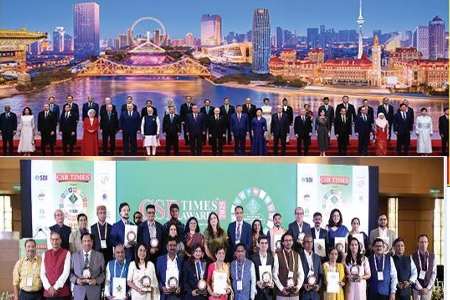
The SCO Summit in Tianjin was the largest in the organization’s history, with 26 nations participating. For India, the summit was an opportunity to reassert its leadership within the Global South, advocate for fairer trade arrangements, and press for accountability in counterterrorism.
SCO Summit 2025 – Key Outcomes
- Modi, Xi, and Putin’s joint appearance
- India’s call for “Multipolar Asia for a Multipolar World”
- Condemnation of Pahalgam terror attack
- Push for climate-resilient infrastructure
- India’s rejection of BRI over PoK sovereignty concerns
Prime Minister Modi’s plenary remarks condemned the April 22 Pahalgam terror attack, which killed 26 civilians, and called for zero tolerance and no double standards in combating terrorism. The summit’s final declaration echoed India’s stance, marking a diplomatic win.
India also promoted climate-resilient infrastructure, sustainable development, and digital public goods, aligning with its G20 priorities. While reiterating opposition to China’s Belt and Road Initiative (BRI), citing sovereignty concerns in Pakistan-occupied Kashmir, India advanced alternatives like Chabahar Port and IMEC.
The optics of Modi, Xi, and Putin walking together sent a powerful message: despite divergent interests, dialogue remains possible. India’s participation highlighted its ability to engage without endorsement, collaborate without compromise, and lead without domination.
India’s growing global influence is reflected in its leadership across multilateral platforms. Its membership in BRICS, SCO, Quad, and the International Solar Alliance positions it as a bridge between developed and developing nations.
During its G20 presidency, India championed the concerns of the Global South, launched the Global Biofuels Alliance, and promoted the Lifestyle for Environment (LiFE) initiative. It also hosted the IMEC dialogue, offering an alternative to China’s BRI.
India’s foreign policy is guided by the ethos of “Vasudhaiva Kutumbakam”—the world is one family. This principle resonates in its outreach to Africa, Latin America, and Southeast Asia, where it is seen as a partner in progress.
As Dr. Govind Gaurav noted in Diplomatist, “India’s challenge lies in balancing its strategic stances between the Global West and the Global East while forwarding its aspirations of leading power in the Indo-Pacific.”
Powerful countries increasingly look to India for stability, mediation, and sustainable development. Its ability to navigate complex alliances, balance competing interests, and champion inclusive growth makes it a natural leader in the emerging world order.
Despite positive momentum, India’s trilateral engagement with China and Russia is fraught with challenges. The border dispute with China remains unresolved, and trust deficits persist. China’s support for Pakistan and its activities in PoK continue to strain ties.
Russia’s deepening dependence on China could complicate India’s strategic calculus, especially if Beijing seeks to leverage this alignment in regional forums. The U.S. tariffs on Indian exports and energy trade with Russia have added another layer of complexity, forcing India to balance economic interests with diplomatic pressures.
India-Russia: Strategic Energy and Trade Ties
- $50B+ crude oil imports from Russia (2024–25)
- Target: $100B bilateral trade by 2030
- INSTC and Chennai–Vladivostok Maritime Route
- New Indian consulates in Kazan and Yekaterinburg
India’s challenge is to maintain strategic autonomy while deepening partnerships. It must avoid being drawn into rigid blocs and instead promote flexible, interest-driven cooperation. This requires institutional reforms, economic resilience, and continued investment in soft power.
“India is not just a market—it’s a strategic anchor.” — Aleksei Zakharov, ORF
The evolving relationship among India, China, and Russia reflects the contours of a new world order—one that is multipolar, interest-driven, and pragmatic. India’s growing influence, diplomatic agility, and developmental leadership make it a central actor in shaping this order.
As tensions rise across the globe—from Ukraine to Taiwan, Gaza to the South China Sea—India’s role as a mediator, partner, and visionary becomes ever more critical. Its ability to engage with diverse powers, uphold sovereignty, and promote peace positions it not just as a rising power—but as a responsible global leader.
India-China: Managing Competition, Seeking Stability
- 2020: Galwan Valley clash
- 2024: LAC patrolling agreement
- 2025: Xi-Modi bilateral at SCO Summit
- Selective cooperation in trade and multilateral forums
- Ongoing mistrust over PoK and South China Sea
- India’s participation in Quad and ASEAN naval drills
In the words of Prime Minister Modi at the SCO Summit: “India stands for peace, progress, and partnership—not polarization. Our future lies in cooperation, not confrontation.”
Sources:
- GeoInflux: India-Russia-China Geopolitical Impact at SCO Summit 2025
- The Diplomat: The Tianjin Summit and the Illusion of a China-India-Russia Axis
- ORF: India-Russia Relations Amid Shifting Geopolitics
- Policy Circle: India Resets China Ties at SCO Summit 2025
- MEA India: Lok Sabha Q&A on India’s Global Influence and Strategic Alliances