
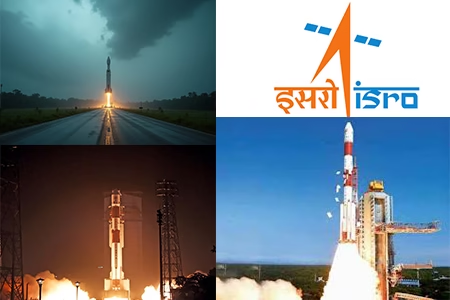
In July 2025, India achieved two historic milestones in space exploration: the Indian Space Research Organisation (ISRO) successfully performed its first autonomous orbital docking maneuver, and Group Captain Subhanshu Shukla became the first Indian astronaut to set foot on the International Space Station. Together, these achievements signal India’s arrival as a serious contender in the global space race.
Precision in Orbit: The Docking Maneuver That Changed Everything
- ISRO’s docking involved two indigenous modules: a passive target and an active chaser.
- The chaser used AI-assisted navigation and onboard sensors to autonomously align and dock.
- This technology is essential for future space stations, crew transfers, and orbital refueling.
When ISRO achieved a landmark feat that redefined India’s space capabilities: its first successful autonomous orbital docking, the maneuver, executed in low Earth orbit, involved two indigenous modules—one passive, one active—designed to align, approach, and lock together without ground control. It was a ballet of precision, powered by onboard sensors, AI-driven navigation, and micro-thrusters working in perfect harmony.
Orbital docking is more than a technical milestone—it’s a gateway to long-duration missions, modular space stations, and international crew exchanges. With this breakthrough, India joins an elite group of nations capable of sustaining human presence in space. It also lays the groundwork for future missions under Gaganyaan and the proposed Indian space station by 2035.
The maneuver’s success reflects years of research, simulation, and indigenous innovation. It demonstrates India’s ability to build complex space systems that operate autonomously in the harsh environment of orbit. For ISRO, it’s a leap from satellite deployment to orbital infrastructure. For the nation, it’s a signal of strategic maturity and global readiness.
This docking wasn’t just a mechanical connection—it was a symbolic one. It linked India’s past aspirations with its future ambitions, locking into orbit a new era of space leadership.
Quote:
“This is not just a technical achievement—it’s a strategic one.”
— Dr. V. Narayanan, ISRO Chairman
A Shared Orbit: Technology and Tenacity
India’s space journey in 2025 is defined not just by machines in motion, but by the human spirit that fuels them. The successful autonomous orbital docking by ISRO and Group Captain Subhanshu Shukla’s mission to the International Space Station represent two sides of the same coin—technological precision and human resilience.
ISRO’s docking maneuver showcased India’s engineering prowess, with indigenous modules aligning and locking in orbit without ground intervention. This breakthrough paves the way for modular space stations, in-orbit refueling, and international crew transfers. It’s a leap toward self-reliant space infrastructure, built on decades of scientific rigor.
Meanwhile, Shukla’s journey—from fighter pilot to astronaut—embodied the tenacity required to thrive in space. His 18-day mission aboard the ISS involved complex microgravity experiments, cross-cultural collaboration, and psychological endurance. His return marked a new chapter in India’s human spaceflight program, inspiring a generation to pursue STEM and space science.
Together, these achievements form a shared orbit of progress. Technology enables the mission; tenacity carries it forward. As India prepares for Gaganyaan and its own space station, this synergy will be vital. It’s not just about reaching space—it’s about staying there, learning, and leading with purpose.
From Lucknow to Low Earth Orbit: The Rise of Subhanshu Shukla
[Subhanshu Shukla’s picture]
Name: Group Captain Subhanshu Shukla
Born: 1985, Lucknow
Education: NDA, IAF Academy, Aerospace Engineering
Flight Hours: 2,000+
Mission: Axiom-4, ISS (18 days)
Career Highlights:
- Selected from ISRO’s astronaut training program for Axiom-4.
- Conducted 60+ microgravity experiments aboard the ISS.
- Became a national icon upon return, greeted by top dignitaries and honored in Parliament.
- Quote:
“I am sure that Subhanshu Shukla’s journey has inspired an entire generation to dream big.”
— Dr. V. Narayanan
India’s Space Milestones
- 1984: Rakesh Sharma flies aboard Soyuz
- 2025: Subhanshu Shukla aboard ISS
- 2025: ISRO’s first orbital docking
- 2030: Gaganyaan crewed mission
- 2035: Indian space station launch
- 2047: Viksit Bharat centenary
India’s space ambitions are no longer confined to launching satellites—they are central to the nation’s developmental roadmap for Viksit Bharat by 2047. With ISRO’s recent success in autonomous orbital docking and the historic ISS mission of Group Captain Subhanshu Shukla, India has signaled its readiness to lead in space innovation, diplomacy, and human exploration.
The government’s ₹20,000 crore investment in space infrastructure reflects a strategic pivot: building indigenous space stations, enabling crewed missions through Gaganyaan, and fostering public-private partnerships with startups like Skyroot and Agnikul. These efforts aim to create a robust space economy, generate high-skilled employment, and position India as a global hub for satellite services, planetary research, and space-based climate solutions.
Beyond technology, India’s space vision is deeply human. It seeks to inspire youth through STEM education, democratize access to space science, and use satellite data to drive inclusive development—from agriculture and disaster management to education and healthcare in remote regions.
As India approaches its centenary, space is not just a frontier—it’s a force multiplier for national progress. The journey toward Viksit Bharat will be powered not only by rockets and research, but by the dreams of a billion citizens reaching for the stars.