

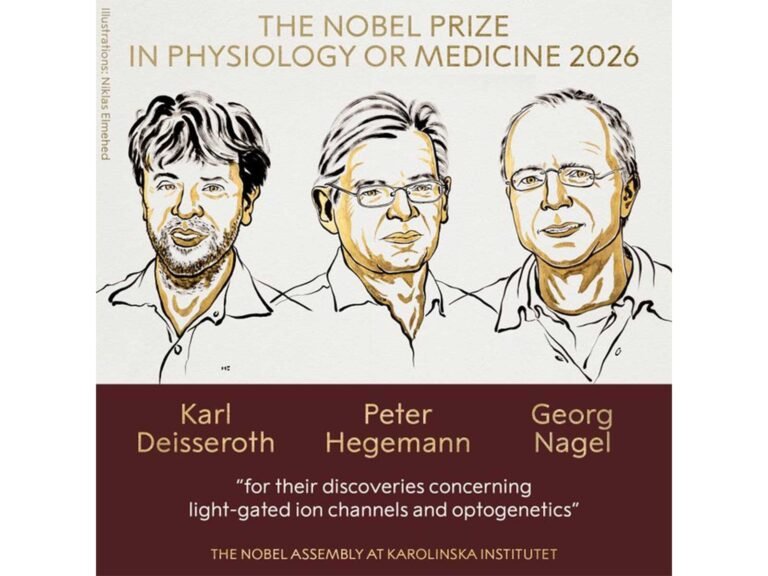
Scientists Karl Deisseroth, Peter Hegemann and Georg Nagel are awarded the 2026 Nobel Prize in Physiology or Medicine for their discoveries concerning light-gated ion channels and optogenetics. The Nobel Assembly at Karolinska Institutet in Stockholm, Sweden, announced on Monday, October 5 in a press gathering.
Thomas Perlmann, secretary of the Nobel Committee for Physiology or Medicine, made the announcement at a press gathering. The Nobel Prize in Medicine recognises major discoveries that have advanced the fields of life sciences and medicine.
The Nobel Assembly said the scientists’ work on optogenetics has given researchers a way to observe how nerve cells influence memories, feelings and behaviours in the living brain.
The foundation for this technique came from the discovery of a protein called channelrhodopsin in a single-celled alga. Peter Hegemann and Georg Nagel identified the protein, while Karl Deisseroth later developed it into a light-controlled switch that could be used in nerve cells.
“Peter Hegemann (Humboldt University of Berlin, Germany) and Georg Nagel (University of Würzburg, Germany) discovered a remarkable protein, channelrhodopsin, in a single-celled alga. Karl Deisseroth (The Howard Hughes Medical Institute and Stanford University, USA) transformed the protein into a light-controlled switch for nerve cells. The Laureates have laid the foundation of a new era in neuroscience,” the Nobel Assembly said.
The award-winning research will help address a major challenge in neuroscience, understanding how the brain governs feelings, behaviour and bodily functions. Scientists in the 20th century had begun identifying areas of the brain linked to particular functions, but the techniques available at the time could not establish whether those areas directly caused the functions being observed.
As the Nobel Assembly explained, the earlier understanding of the brain resembled “a sketch map, full of question marks and unknowns.” According to the Assembly, optogenetics is now changing that picture.
Per Svenningsson, Chair of the Nobel Committee for Physiology or Medicine, said optogenetics has created opportunities to map the brain in ways that researchers could previously only imagine. The discoveries made by Hegemann, Nagel and Deisseroth have therefore opened a new direction in neuroscience and are helping scientists investigate one of humanity’s fundamental scientific questions: how the brain works.
The Medicine award is the first of six Nobel Prizes scheduled to be announced over eight days.
The Nobel Prize includes a medal, diploma and cash award. For 2026, the prize amount has been set at 12 million Swedish kronor for a full Nobel Prize. The awards will be formally presented to the scientists in December.